

Every year on 29 November, the world commemorates the International Day of Solidarity with the Palestinian People, a moment that reminds us that the humanitarian tragedy in Palestine is not a new episode but the continuation of more than seven decades of oppression. The date was chosen because on 29 November 1947, the UN General Assembly adopted Resolution 181—the partition plan that allocated 44% of historic Palestine to the Arab Palestinians, 55% to a Jewish state, and 1% as an international zone in Jerusalem.
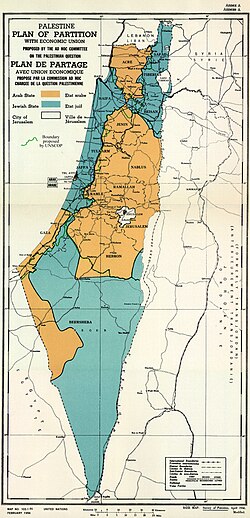
UNSCOP (3 September 1947; see green line) and UN Ad Hoc Committee (25 November 1947) partition plans. The UN Ad Hoc Committee proposal was voted on in the resolution.
This plan—depicted in the official partition map—was wholly rejected at the time by the Palestinian people and the Arab states, yet warmly embraced by the international Zionist movement, which saw it as a legal stepping stone to enforce and legitimise its colonial project.
The plan did not emerge in a historical vacuum. It was the extension of earlier British colonial decisions such as the 1917 Balfour Declaration and the 1937 Peel Commission proposals, both of which sidelined the voices of the indigenous Palestinians. Earlier still, UNSCOP—the UN committee established to assess the future of Palestine—operated for only three months and was significantly influenced by Zionist lobbying, proving that Palestine’s fate was determined not by its own people’s aspirations but by the manoeuvres and dominance of global powers. These biased decisions paved the way for the 1948 Nakba, when more than 750,000 Palestinians were expelled, their villages destroyed from Haifa to Beersheba, and ethnic cleansing carried out systematically. The Nakba is not merely a historical tragedy; it remains an open wound that continues to bleed until today.
As we step into 2026, the International Day of Solidarity with Palestine arrives in the darkest and most tragic atmosphere since the 1948 Nakba—a darkness now unfolding before our eyes in real time, no longer through historical writings but directly through the devices in our hands. This phenomenon not only dulls moral sensitivity but normalises brutality, turning human catastrophe into a daily spectacle that no longer moves the conscience. The Palestinian people are not numbers and not statistics for consumption.
Two years after the events of 7 October 2023, Gaza remains crushed under a sustained campaign of genocide and apartheid that has claimed more than 160,000 lives—killed or injured—most of them women and children, while more than 10,000 remain missing beneath the rubble. Starvation has begun to take the lives of children and the elderly, transforming Gaza not merely into a war zone but an open-air graveyard that exposes the total collapse of the global system. This is a dark chapter in modern human history: a large-scale destruction that has occurred in the open, fully documented and recorded, yet the world still fails to stop this unfolding human apocalypse. Worse still, the international system that claims to safeguard peace has not only failed to prevent the atrocities but has become a silent witness to the destruction of an entire people.
In the face of this tragedy, the world has not only awakened but must continue to rise with consistency and courage. Massive demonstrations have filled the streets of global capitals; universities are leading academic boycotts; student convocations have turned into acts of solidarity; several governments have severed diplomatic ties with Israel; and 137 UN member states have recognised the State of Palestine—representing the majority of nations on earth. International bodies such as the International Criminal Court (ICC) have issued arrest warrants for the perpetrators of genocide, including Benjamin Netanyahu and Yoav Gallant. This global wave of solidarity demonstrates that Palestine is no longer a peripheral issue but the moral barometer of the modern world—testing whether we still possess conscience, moral courage, and the human compass to stand for justice.
Yet it would be a grave misfortune if, after witnessing two years of relentless slaughter, suffering and oppression, some among us have begun to feel numb and spiritually dead—able to watch children die of starvation, mothers lose their families, and entire neighbourhoods turned into mass graves without the slightest tremor of the heart. Do we not realise that this is the most dangerous sign, when the human heart no longer trembles in the face of injustice? More frightening still—have we considered that what happens in Palestine could one day happen to us? If the world can remain silent in the face of such blatant oppression, what guarantee is there that the world will defend us when our turn comes?
What is happening in Palestine today is not merely a test for them—it is a test for all of us. A test of our belief in justice. A test of our commitment to humanity. A test of our courage to speak truth in the face of cruelty and power. Palestine is suffering a wound of the body, but the world—including us—is being tested with a wound of the soul: whether we still possess living hearts, seeing eyes, and consciences that are not dead.
Yet as the world watches and demands justice, a deeply concerning development has emerged: what Donald Trump calls the “Gaza Peace Plan.” Announced with theatrics as though offering a solution, its contents reveal the new face of an old colonial project. The plan proposes Gaza be administered by an apolitical technocratic committee under international supervision, with Trump himself chairing a “Board of Peace.” Hamas is asked to disarm, yet no clear requirement is placed on Israel to withdraw, let alone to be held accountable. Israel continues bombing, killing and shooting Palestinians with impunity. It even seeks to maintain security perimeters even after a so-called withdrawal. The creation of a Palestinian state is mentioned only vaguely with no concrete commitments.
If viewed uncritically, this plan repeats the same historical mistakes: placing Palestine under foreign control while allowing the coloniser to retain power. It echoes how Resolution 181 was used as a tool to seize Palestinian land and how UNSCOP, which claimed neutrality, failed due to Zionist lobbying. The core problem with Trump’s plan is clear: it does not end colonisation; it merely attempts to manage it with a new diplomatic mask. It demands the victim lay down arms while allowing the coloniser to remain armed. It demands Palestinian surrender in the name of “peace” even though peace cannot exist without genuine freedom.
Malaysia—through Wisma Putra—must remain firm that peace does not mean surrender. Peace cannot be created through plans that preserve injustice. True peace can only exist when Palestinians are truly free to determine their own future without foreign control, without Israeli military perimeters, and without lopsided conditions that extinguish their struggle for liberation. The sovereignty of a Palestinian state must be the foundation, not an optional detail.
In this context, Ilan Pappé, in his latest book Israel on the Brink: Eight Steps for a Better Future, argues that status-quo solutions—including the two-state model—are insufficient because they do not dismantle the colonial structures and power asymmetry that continue to oppress Palestinians today. He proposes the idea of “Decolonization and Coexistence”: rebuilding political and social systems that are genuinely inclusive after colonisation has truly ended, so that peaceful coexistence can emerge based on equality of rights, not domination.
This view aligns with Mahatma Gandhi’s warning in his letter to Jewish philosopher Martin Buber in the 1930s:
“If I had been convinced that the Jews of Europe wanted to live alongside the Arabs of Palestine, I would have been the greatest supporter of Zionism. My impression is that you want to live instead of the Palestinians, and therefore you will never get my blessing for such a colonialist project.”
The International Day of Solidarity with the Palestinian People reminds us that true justice is still being delayed. The rights of Palestinians to self-determination, to establish a sovereign state with East Jerusalem as its capital, and the right of refugees to return to their homeland remain unfulfilled, even though the UN recognises them as inalienable rights. As long as these fundamental demands remain unmet, any peace plan is merely cosmetic—an attempt to mask an unchanged structure of colonisation.
ABIM affirms that solidarity with Palestine is not a political option but a moral duty. It requires us to understand true history, reject manipulated narratives, and recognise the truth that Palestine is not the victim of a symmetrical conflict but the victim of colonisation. In a world that is increasingly losing its moral compass, standing shoulder-to-shoulder with Palestine is proof that humanity can still defend justice.
As long as Gaza is bombarded, as long as the West Bank is seized, as long as Palestinian refugees are denied return, and as long as new “peace plans” continue trying to legitimise old oppression, the Day of Solidarity will remain relevant. Palestine does not need a new plan that erases its rights. Palestine needs the justice that has long been denied.
ABIM stands firm on the principle that justice cannot be negotiated by the coloniser, and liberation cannot be replaced by technocratic administration. Palestine will only be free when colonisation truly ends and its people are able to determine their future independently. And herein lies the true meaning of solidarity—that we will not stop speaking out until justice is delivered.
Ahmad Fahmi bin Mohd Samsudin
President
Angkatan Belia Islam Malaysia (ABIM)