


PRESS STATEMENT
ANGKATAN BELIA ISLAM MALAYSIA (ABIM)
RETURNING TO MERCY, JUSTICE, AND HUMAN DIGNITY IN ADDRESSING THE REFUGEE ISSUE
06 June 2026 | 20 Zulhijjah 1447H
The Islamic Youth Movement of Malaysia (ABIM) expresses its deep regret over the escalating narrative of extreme hatred directed toward Rohingya refugees by some social media users recently.
More alarmingly, there are also statements inciting the public to take matters into their own hands, including threats of violence against any Rohingya individual encountered. Such calls not only contradict the principles of law and humanity, but also directly violate Islamic teachings that uphold justice and protect the dignity of every human being.
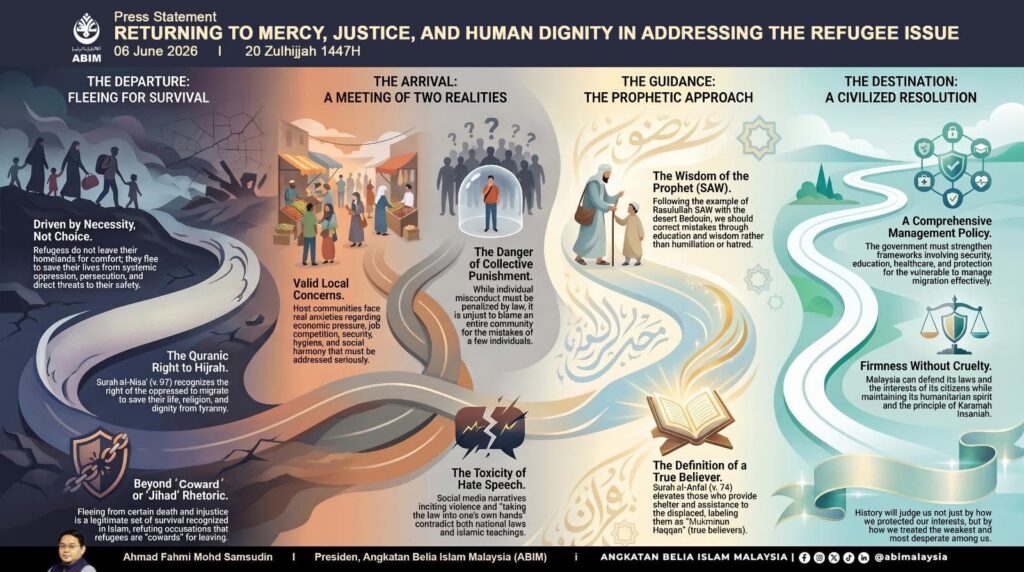
At the same time, ABIM understands that a segment of the public harbors genuine concerns and anxieties regarding issues of security, economic pressure, job opportunities, environmental cleanliness, and social harmony associated with the presence of the refugee community. These anxieties should not be taken lightly or simply dismissed. They must be addressed seriously through policies that are more structured, effective, and grounded in the rule of law.
Nevertheless, legitimate anxieties must not transform into hatred against an entire group of human beings. Islam teaches us to be just when evaluating any matter. If individuals commit offenses, action must be taken against the wrongdoers without collectively punishing the entire community. Blaming an entire group for the wrongdoings of a few is not only unjust, but will only further exacerbate tension and division within society.
ABIM invites the entire community to seek forgiveness from God (istighfar), remain calm, and return to holding fast to Islamic values that demand justice, mercy (rahmah), decorum (adab), and the preservation of the dignity of every human being.
Refugees, including the Rohingya ethnic group, are oppressed people in need of protection. They did not leave their homeland merely to seek a comfortable life, but because they were forced to flee from oppression, persecution, and threats to their safety.
Characterizing them as cowards or accusing them of fleeing from jihad is inconsistent with the true understanding of Islam. The Quran itself recognizes the right of the oppressed to migrate to save their lives, religion, and personal dignity. Allah SWT reminds us in Surah al-Nisa’, verse 97, that under certain circumstances, migrating from oppression is part of the obligation to save oneself from tyranny.
Allah SWT states in Surah al-Anfal, verse 74:
“And those who have believed and emigrated and fought in the cause of Allah and those who gave shelter and aided – it is they who are the believers, truly.”
This verse elevates the status of those who migrate due to oppression, and honors those who provide shelter and assistance to them as mukminun haqqan (true believers).
ABIM does not deny that there are challenges and issues that need to be jointly addressed in the relationship between the local society and the refugee community. However, the solution lies not in hatred, racial insults, or violence, but through an approach that is just, wise, and responsible.
In this regard, we should emulate the Prophet Muhammad SAW when facing a Bedouin Arab who urinated inside the Prophet’s Mosque (Masjid Nabawi). The Prophet SAW did not allow harsh actions against him, but instead chose a calm and wise educational approach. Mistakes must be corrected, but human beings should not be humiliated or treated with hatred.
ABIM is of the view that the refugee issue cannot be viewed narrowly or oversimplified with the rhetoric of hatred. It is part of a larger humanitarian crisis involving prolonged conflict, denial of basic rights, the failure of international protection, and migration management challenges that require the cooperation of various parties at national, regional, and international levels.
Therefore, ABIM urges the government to continue strengthening a more comprehensive approach to managing the refugee issue, including aspects of security, education, healthcare, protection for vulnerable groups, and relations with the local community. An effective approach must be capable of protecting the interests of Malaysian citizens without sacrificing the principles of humanity and justice, which form the bedrock of a civilized nation.
The refugee crisis is a major test for society and the nation. It tests not only our socioeconomic and political capacities, but also the level of our faith, morality, and humanity. In facing this complex issue, society must reject both extremes: denying the existing problems, and legitimizing hatred against an entire group of human beings.
Malaysia has every right to defend its sovereignty, public safety, and the interests of its people. Yet at the same time, Malaysia must not lose its humanitarian face. We can be firm without being cruel. We can manage the challenges of refugees effectively without sacrificing the principles of mercy (rahmah) and human dignity (karamah insaniah).
Ultimately, how we treat the weakest and most vulnerable among us will reflect the values we hold as a nation. History will judge us not only by how we defended the interests of our citizens, but also by how we treated human beings who came to us in their most desperate time of need.
ABIM calls upon the entire community to open their hearts, halt extreme racial narratives, reject any calls to violence, and together build a culture of peace based on justice, compassion, and respect for human dignity.
May Allah SWT grant us the strength to continue to be just, patient, and helpful to the oppressed, so that we may be numbered among the mukminun haqqan.
‘Upholding Truth and Justice’
AHMAD FAHMI MOHD SAMSUDIN
President
Angkatan Belia Islam Malaysia (ABIM
